


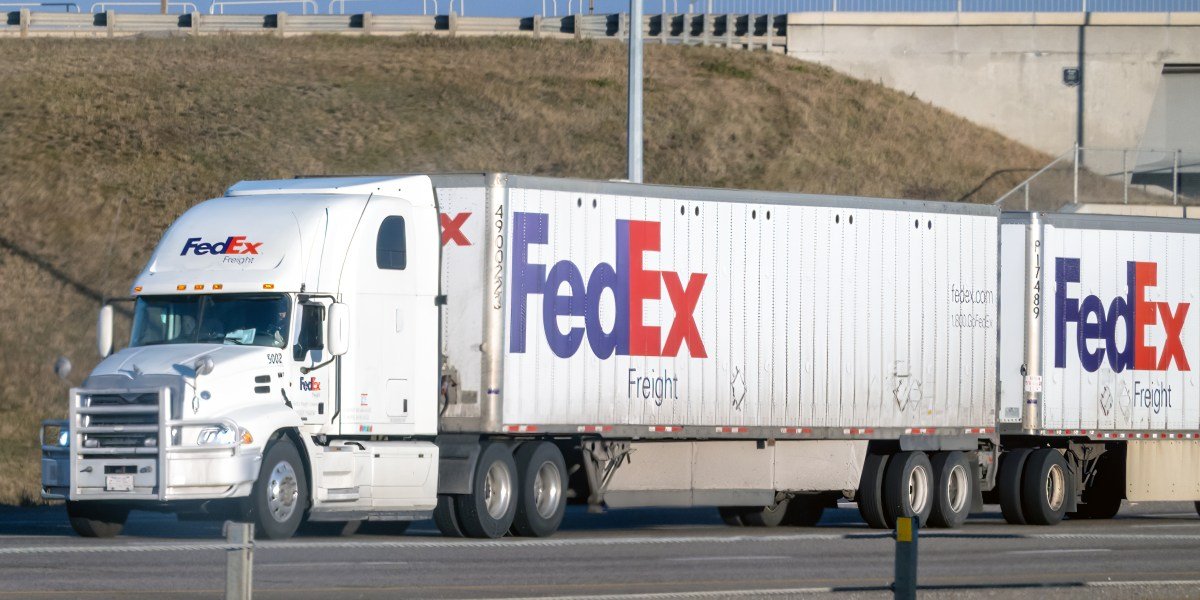
At what point does a business need a different operating model? FedEx Freight CEO John Smith believes his company has reached that point.
The newly independent company, which spun off from FedEx earlier this month, generates roughly $9 billion in annual revenue and operates one of the largest less-than-truckload networks in North America. Until recently, however, it sat inside a parent company approaching $90 billion in annual revenue.
That difference in scale shaped everything from capital allocation to technology investments, Smith told me during a recent interview.
“Rightfully so, the majority of that will go into the mothership,” he said, referring to how investment decisions naturally flowed toward FedEx’s much larger parcel business.
One theme surfaced repeatedly throughout our conversation: control. Control over capital allocation, technology investments, the sales organization, and the company’s approach to growth opportunities in healthcare, food and beverage, and small-business customers.
For years, FedEx Freight operated with technology, finance, sales, and back-office functions integrated with the broader FedEx organization. As the freight market evolved, many of those systems became increasingly optimized for parcel delivery rather than the needs of the less-than-truckload market.
The separation, in Smith’s view, is less an endpoint than a starting point. He quickly shifted the conversation toward the work ahead: modernizing technology, building a dedicated sales force, using AI and machine learning to improve network performance, expanding in healthcare, and winning back small and midsize customers. Independence, he believes, creates the freedom to pursue those priorities without competing against the needs of a much larger parcel operation.
One example involves the vast amount of operational data moving through the company’s network. FedEx Freight already captures dimensional data on freight shipments, allowing it to understand not only how much a shipment weighs but also how much space it occupies inside a trailer. The opportunity now is to use AI and machine learning to turn that information into smarter decisions about capacity utilization, routing, and pricing.
Small and midsize businesses represent another significant opportunity. According to Smith, FedEx Freight historically underperformed in that segment because it was often difficult for customers to do business with the company. Healthcare is another area of focus, with plans to build on relationships established elsewhere within FedEx while expanding deeper into medical equipment and other specialized freight categories.
The tension he describes will sound familiar to many executives. Large organizations benefit from scale, shared resources, and centralized systems. Over time, however, individual businesses often develop their own technology needs, customer expectations, and competitive pressures.
FedEx Freight’s separation offers one answer to that challenge. The underlying argument is that a business can be large, profitable, and strategically important while still requiring a different operating model to reach its next stage of growth.
Whether that bet pays off will become clear in the years ahead. For now, the company’s spin-off highlights a question many leaders eventually confront: When does the structure that helped build a business become the very thing holding it back?
Ruth Umoh
ruth.umoh@fortune.com
Smarter in seconds
Rocket rebound. SpaceX went from three consecutive rocket explosions and near-bankruptcy in 2008 to the biggest IPO in history
Mission Control. Meet Gwynne Shotwell, the engineer-turned-COO who runs SpaceX in platform heels and is now worth over $2 billion
Leadership lesson
FedEx Freight’s CEO on intellectual curiosity: “Even when you think you’ve learned everything, you’ve got to keep learning. That’s where I think some people mess up when they think they know everything. You don’t.”
News to know
U.S. stock futures surged and oil prices fell after Washington and Tehran confirmed a deal to reopen the Strait of Hormuz. Fortune
Fox is acquiring Roku in a roughly $22 billion deal, combining a major media company with one of the largest streaming platforms and connected-TV ecosystems. Reuters
The Trump administration reportedly blocked foreign access to Anthropic’s new Fable 5 AI model after concerns raised by Amazon CEO Andy Jassy. Fortune
Even seasoned wealth managers struggle to grasp managing Elon Musk’s trillion-dollar fortune, whose sheer size could influence economies. Fortune
Software engineers who once enjoyed unparalleled job security and pay are now grappling with uncertainty as AI reshapes coding work. WSJ
SpaceX President Gwynne Shotwell floated the possibility of a future merger with Tesla, suggesting it could simplify Elon Musk’s increasingly sprawling empire. Fortune
A year after Mark Zuckerberg hired Alexandr Wang to reboot Meta’s AI ambitions, he’s still trying to convince developers and investors that it can compete with OpenAI and Google. CNBC
