


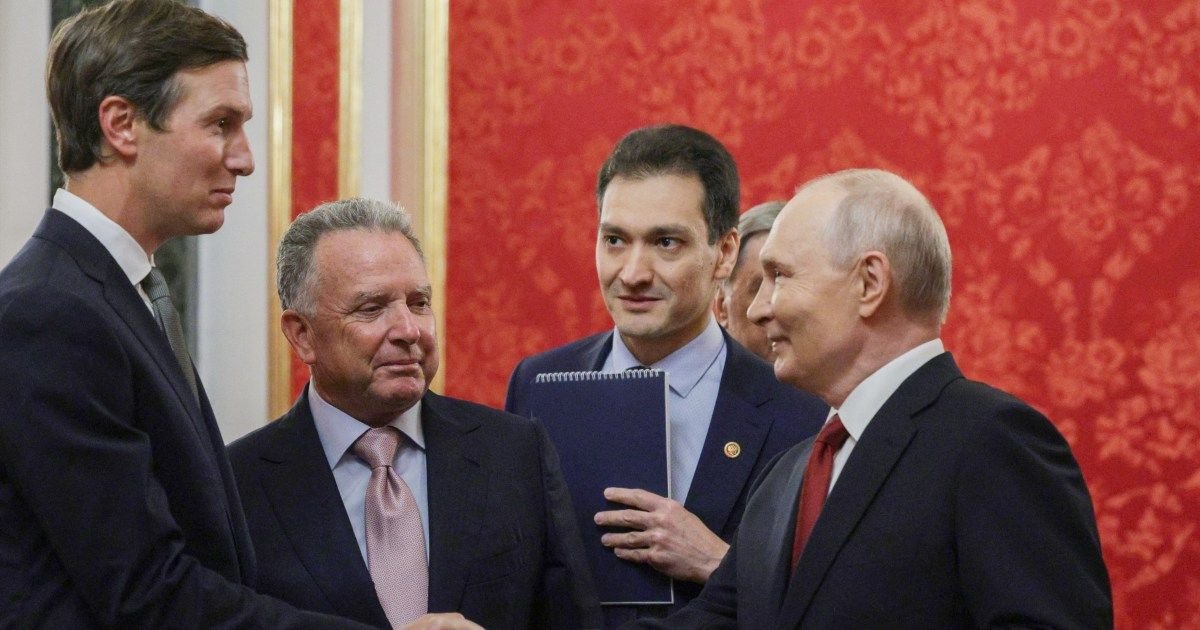
The visit by White House envoys Steve Witkoff and Jared Kushner to Moscow and Kyiv has left more questions than answers. Details of what was discussed in both meetings are scant, but all participants seem to describe them as “positive”.
It is indeed a positive development that US President Donald Trump is trying to jump start negotiations at this point. The biggest problem he faces is that Russia’s position has only hardened.
Russia wants Ukraine to be genuinely neutral, with no Western military presence, open or clandestine. It wants to keep previously occupied territories and it insists that Ukraine withdraw from the small part of Donbas that remains in its hands.
Moscow demands a cap on the size of the Ukrainian army and on the types of weapons it may possess. It also wants far-right units and paramilitary groups disbanded and outlawed, the legislation limiting the use of the Russian language cancelled and elections to be held in which Russia-friendly parties could compete freely with the pro-Western ones.
For Ukraine and its European backers, this would be a hard pill to swallow, all the more so after spending the summer trying to convince the European public and Trump that the “tide is turning” in the war.
As evidence, Ukrainian and Western officials have repeatedly pointed to the Russian offensive slowing down and Ukraine intensifying strikes deep within Russian territory, targeting oil facilities and causing fuel shortages across the country.
The campaign against Russian energy infrastructure was meant to coerce Russian President Vladimir Putin into accepting peace on conditions more favourable to Ukraine.
But the opposite has happened. Russia’s negotiating position is now even less open to compromise. The land swap, once eyed as a way to compensate Ukraine for its withdrawal from the Donbas region, is now out of the question.
Meanwhile, the Kremlin has launched its own devastating campaign of strikes aimed at collapsing Ukraine’s economy. In addition to shutting down exports of Ukraine’s main commodities, grain and ore, through Odesa ports, Russia is also methodically destroying logistical hubs and warehouses owned by large retailers as well as large-scale industry, from metallurgical plants to beverage factories.
This is the point when Trump’s peacemaking duo resurfaced on the Russo-Ukrainian front after a protracted absence. The very fact that Kushner and Witkoff embarked on this trip and were received by Putin personally signals a change of tack in Washington.
A week before their arrival, CIA director John Ratcliffe mysteriously appeared in Moscow. Ratcliffe was effectively snubbed by Putin, who refused an audience when the CIA chief’s convoy reached the Kremlin. Instead, Ratcliffe had meetings with the heads of Russian security agencies, FSB and SVR, before heading home.
Nothing emerged from this meeting, apart from media speculation based on dubious sourcing. Hawkish media outlets claimed that Ratcliffe arrived with a stern warning against Russia attacking East European NATO members.
Others claimed Ratcliffe was trying to convey the “tide is turning” narrative to Putin and push for new negotiations based on that. The Atlantic magazine claimed last month that it was the CIA director who planted the idea that Russia was beginning to lose into Trump’s head during golf games.
Russian emigre outlet Agentstvo confirmed, quoting a Kremlin source, that Putin cancelled the meeting after hearing what Ratcliffe had been telling his subordinates and concluding that he was delusional.
Whether that is true or not, it is quite telling that Ratcliffe, who is a more senior US official than Kushner and Witkoff, was turned away, while they received a warm welcome in Moscow and spent a considerable time with Putin. Clearly, Trump’s envoys did not make the long trip to repeat what the Russian president sees as Western propaganda.
Whether Kushner and Witkoff’s mission has added anything substantial to the peace process is another question. They expressed cautious optimism regarding their progress. They said that no immediate breakthrough was foreseen but were eyeing direct trilateral talks between Russia, Ukraine and the US.
What is remarkable about the Witkoff-Kushner mission is the sheer number of commentators who were all too keen to claim that it was doomed from the outset. This is a reflection of the power pro-war circles continue to wield, despite growing war fatigue in Western societies.
The pro-war party simply wants any talks with Russia to be doomed, like they wanted the Istanbul talks to be doomed in the spring of 2022 and Minsk agreements to be ditched before that.
In trying to jump-start the peace talks, Trump will also have to face off with this party, which includes, European governments, NATO leadership and parts of the political establishment in his own country.
He would be keen to achieve some progress in peace talks prior to midterm elections and pressure Putin into limiting his military cooperation with Iran, but that’s impossible to achieve while the US plays a crucial role in helping Ukraine target infrastructure in Russia’s own territory.
Meanwhile, Ukraine’s resilience is increasingly under question amid continuing brutal bombardment by the Russian army. As winter approaches, the targeting of energy and water infrastructure could severely worsen living conditions in the country.
Kyiv is already shaken by a political crisis, aggravated by corruption scandals involving top officials close to Zelenskyy, as well as a turf war between security agencies. There is also a $26bn gap in the Ukrainian defence budget, which needs to be covered by Western aid that’s not necessarily forthcoming.
There is no limit to warmongers pressuring Ukraine into fighting a suicidal war with a far stronger rival, but there is a limit to how long Ukrainians would be willing to die for an agenda that’s increasingly at odds with their national and personal interests.
The views expressed in this article are the author’s own and do not necessarily reflect Al Jazeera’s editorial stance.
