


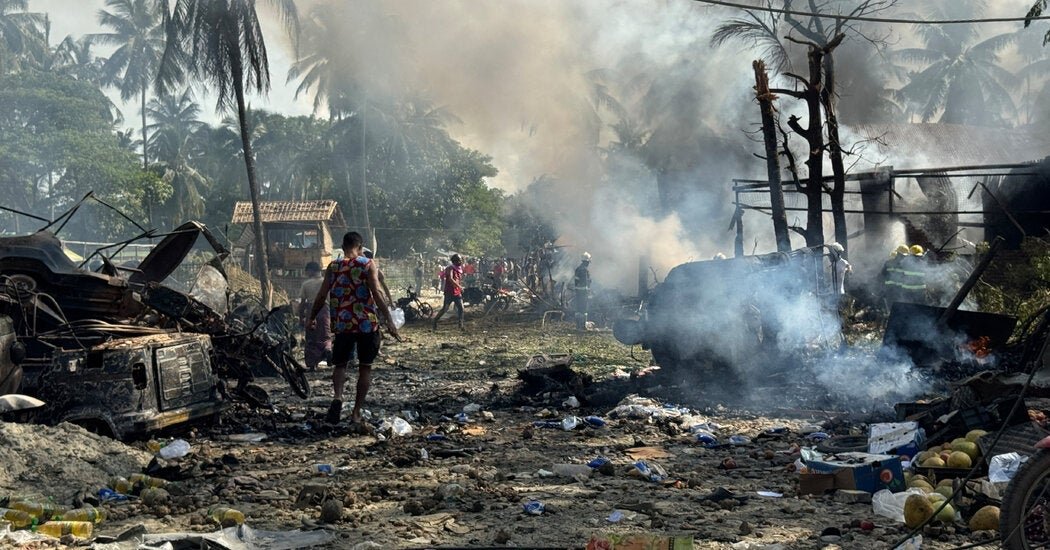
Nineteen-year-old Su Chay was on one of her regular shopping runs at the bustling street market in her town in western Myanmar when her father heard an explosion. Stepping out of their home, he saw plumes of smoke.
A military jet had dropped two bombs, as he would later find out, incinerating the market.
When he got there, Ms. Su Chay’s father, Kyaw Than, saw dozens of bodies in flames. “They looked like pieces of charcoal,” he said. “Some were still burning, but they were already dead.”
He added: “This is a market used by civilians. Bombing a place like this is killing civilians.”
At least 50 people were killed and 58 injured in the attack in Kyauktaw town, according to the local authorities. The town is in Rakhine State, an area controlled by the rebel Arakan Army.
Myanmar has been racked by years of civil war and the toll on civilians has been staggering. More than 100,000 people have been killed in the fighting, which followed a coup in 2021, according to the Armed Conflict Location & Event Data Project. Millions have been displaced from their homes, and the United Nations estimates that more than 12 million will face acute food shortages this year.
The Arakan Army had been fighting the Myanmar military for years before the coup, in an effort to form an independent state for ethnic Rakhine Buddhists. Rakhine is also the traditional homeland for the minority Rohingya Muslims, who have faced persecution by Myanmar’s military, as well as by the Arakan Army, which now controls a vast majority of the state.
“A.A. will soon retaliate against everyone involved in the airstrikes,” Khaing Thu Kha, a spokesman for the rebel group, said in a telephone interview on Tuesday, referring to it by its initials. He said that the attack constituted a war crime.
A spokesman for the military was not reachable for comment but it has previously said that it only targets “terrorists.” But last December, Myanmar’s military dropped two bombs on a hospital in Rakhine State, killing 34 people and injuring dozens of others.
Monday’s bombing came around noon. Crowds had gathered at the market as food and other products imported from India were being unloaded from trucks, according to Wai Hun Aung, an independent aid worker.
The victims included both ethnic Rakhine and Rohingya, he said.
“I saw one woman who had been sitting when she was burned to death,” he said. “I also saw the body of a child who looked about 1 year old, along with a woman believed to be the child’s mother.”
As he and other aid workers scrambled to help survivors, they also worried about their safety.
“The military has a history of carrying out more airstrikes when large groups of people gather,” he said. “So while we are helping people on the ground, we also have to keep looking up because we are afraid a jet fighter could come back and bomb the area again.”
Some families have taken away the remains of their loved ones to mourn. But Mr. Kyaw Than is still searching for Ms. Su Chay.
“Her body is not among the bodies that can be identified,” he said. “I don’t know if she was killed and her body was burned and broken apart so badly that no one can recognize her.”
