


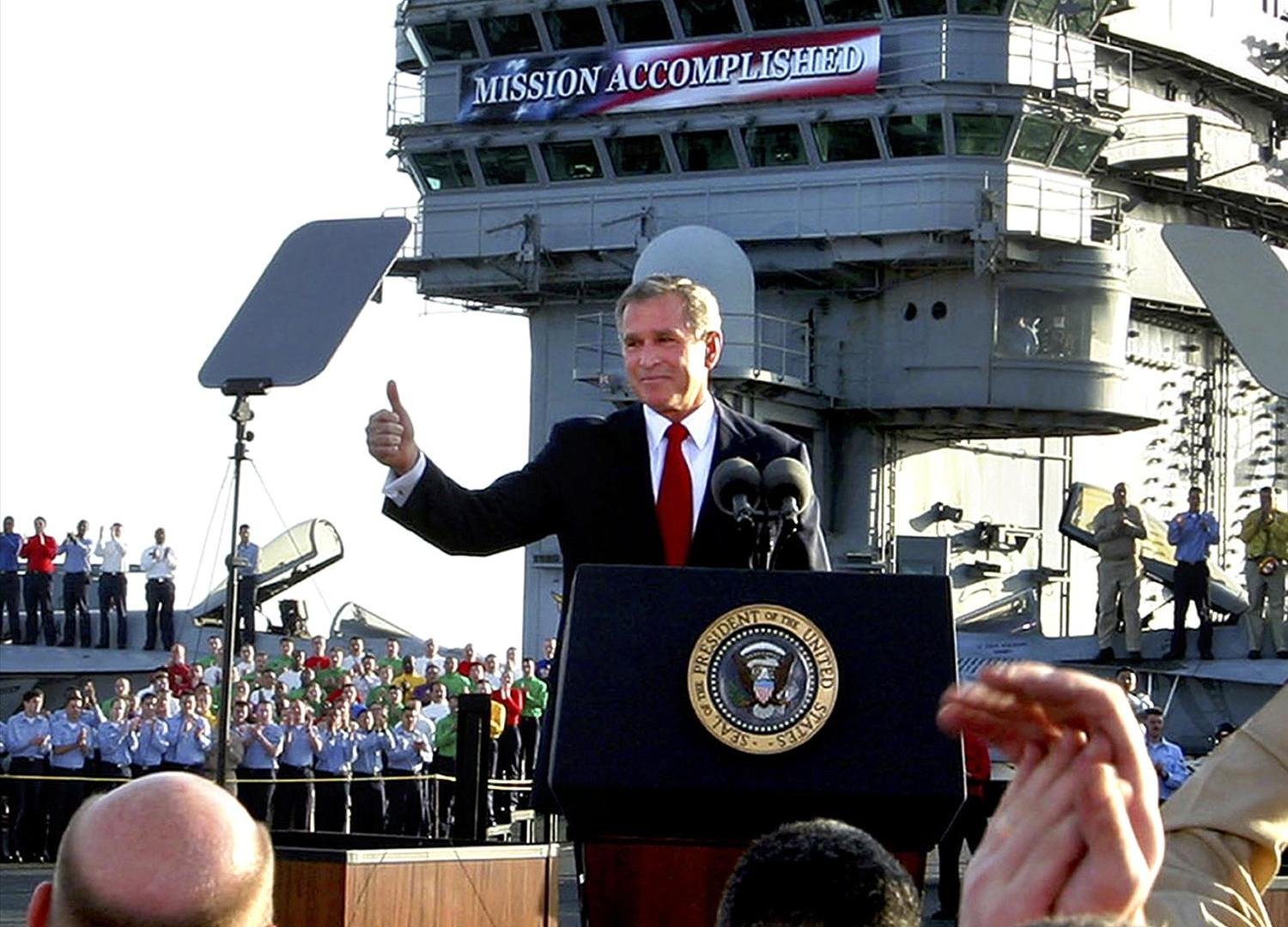
In January 2003, President George W Bush stood before the United States Congress to warn of a “grave danger” from a “dictator”, a former US client in the Middle East, armed with weapons of mass destruction (WMD).
Twenty-three years later, in the same chamber, President Donald Trump used his State of the Union address to paint a strikingly similar narrative: A rogue regime, a looming nuclear threat, and a ticking clock.
Recommended Stories
list of 4 itemsend of list
In a dark twist of historical irony, Iraq’s Saddam Hussein, who was armed to the teeth by the US in Iraq’s 1980-1988 war with the fledgling Islamic Republic of Iran, became Washington’s public enemy number one, surpassing Osama bin Laden. Now, that label has been seemingly applied to Iran’s Supreme Leader Ayatollah Ali Khamenei, a key leader during that ruinous war against Iraq that left a million dead.
But while the “war script” sounds familiar, the geopolitical stage has shifted dramatically.
As Washington pivots from the neoconservatives’ “preemptive” doctrine of the Bush era to what experts are calling the “preventive maintenance” of the Trump era – following the June 2025 strikes on Iran in tandem with Israel’s attack in the 12-day war – questions are mounting about the intelligence, the endgame, and the alarming lack of checks and balances.
The semiotics of fear: From clouds to tunnels
In 2003, the visual language of war was vertical: The fear of a “mushroom cloud” rising over US cities, or a biological weapon seeping into populated areas. Today, the fear has gone in the other direction: Purportedly deep underground.
“The administration is updating the visual dictionary of fear,” says Osama Abu Irshaid, a Washington-based political analyst. “They are exaggerating the nuclear threat exactly as the Bush administration did with the ‘smoking gun’ metaphor. But there is a key difference: In 2003, US intelligence was manipulated to align with the lie. In 2026, the intelligence assessments actually contradict Trump’s claims.”
While Trump asserted in his State of the Union address that Iran is “rebuilding” its nuclear programme to strike the US mainland, his own officials offer conflicting narratives. White House spokesperson Karoline Leavitt insisted Tuesday, parroting her boss, that the 2025 “Operation Midnight Hammer” had “obliterated” Iran’s facilities. Yet, days earlier, Trump envoy Steve Witkoff claimed Tehran was “a week away” from the bomb.
This “information chaos”, analysts argue, serves a specific purpose: Keeping the threat vague enough to justify perpetual military pressure.
“Bush benefitted from the post-9/11 anger to link Iraq to an existential threat,” Abu Irshaid told Al Jazeera. “Trump doesn’t have that. Iran hasn’t attacked the US homeland. So, he has to fabricate a direct threat, claiming their ballistic missiles can reach America – a claim unsupported by technical realities.”
The regime change quagmire
Perhaps the most glaring contrast with 2003 is the internal coherence of the administration.
The Bush team – Vice President Dick Cheney, Defense Secretary Donald Rumsfeld and his deputy Paul Wolfowitz – moved in ideological lockstep. Cheney famously predicted US troops would be “greeted as liberators”.
They were anything but. The made-for-television scene of a statue of Saddam Hussein being torn down in central Baghdad quickly gave way to sustained, organised fighting against the US occupation, heavy US troop losses, as well as sectarian bloodletting that forced Iraq onto the cusp of all-out civil war.
Bush declaring major combat operations over under a huge “Mission Accomplished” banner in May 2003 came back to haunt his administration and the US for years to come.
The Trump team of 2026 appears far more fractured, torn between “America First” isolationism and aggressive interventionism.
- The official line: Vice President JD Vance and Defence Secretary Pete Hegseth have publicly stated the goal is not regime change. “We are not at war with Iran, we’re at war with Iran’s nuclear programme,” Vance said Sunday.
- The president’s instinct: Trump contradicted them on social media, posting: “If the current Iranian Regime is unable to MAKE IRAN GREAT AGAIN, why wouldn’t there be a Regime change??? MIGA!!!”
“The Neocons who hijacked policy under Bush have been weakened,” notes Abu Irshaid. “But they have been replaced by figures like Stephen Miller, who holds absolute loyalty to Trump and close ties to the Israeli right. Trump is driven by instinct, not strategy. He seeks the ‘victory’ that eluded his predecessors: The total hollowing out of Iran, whether through zero-enrichment surrender or collapse.”
The lonely superpower: Coercion over coalition
In 2003, Bush and United Kingdom Prime Minister Tony Blair worked tirelessly to build a “Coalition of the Willing”. It was a diplomatic veneer, but it existed. Blair remains a much-loathed figure in the Middle East and in some quarters in the West for giving diplomatic cover to the Iraq debacle.
In 2026, the US is operating in stark isolation.
“Trump is not building a coalition; he is alienating allies,” Abu Irshaid explains. He points to a pattern of “extortion” extending from tariffs on the European Union to attempts to “buy” Greenland. “The Europeans see the coercion used against Iran and fear it could be turned against them. Unlike 2003, only Israel is fully on board.”
This isolation was highlighted when the UK reportedly refused to allow the US to use island bases for strikes on Iran, forcing B-2 bombers to fly 18-hour missions directly from the US mainland during the 2025 campaign.
The collapse of checks and balances
Following the damning intelligence failures and lies of the Iraq war, promises were made to strengthen congressional oversight. Two decades later, those guardrails appear to have vanished.
Despite efforts by US Representatives Ro Khanna (a Democrat) and Thomas Massie (a Republican) to invoke a “discharge petition” to block an unauthorised war, the political reality is grim.
“The concept of checks and balances is facing a severe test,” warns Abu Irshaid. “The Republican Party is now effectively the party of Trump. The Supreme Court leans right. Trump is operating with expanded post-9/11 powers that allow for ‘limited strikes’ – strikes that can easily spiral into the open war he claims to avoid.”
With the administration citing “32,000” protesters killed by Tehran – a figure significantly higher than independent estimates, and which Iran dismissed as “big lies” on Wednesday – the moral groundwork for escalation is being laid, bypassing the need for United Nations resolutions or congressional approval.
As US and Iranian negotiators meet in Geneva for make-or-break talks under the shadow of last year’s “Operation Midnight Hammer”, the question remains: Are the two nations with decades of enmity boiling between them on the brink of a new deal, or the prelude to a war that could ignite the entire region in flames?
