


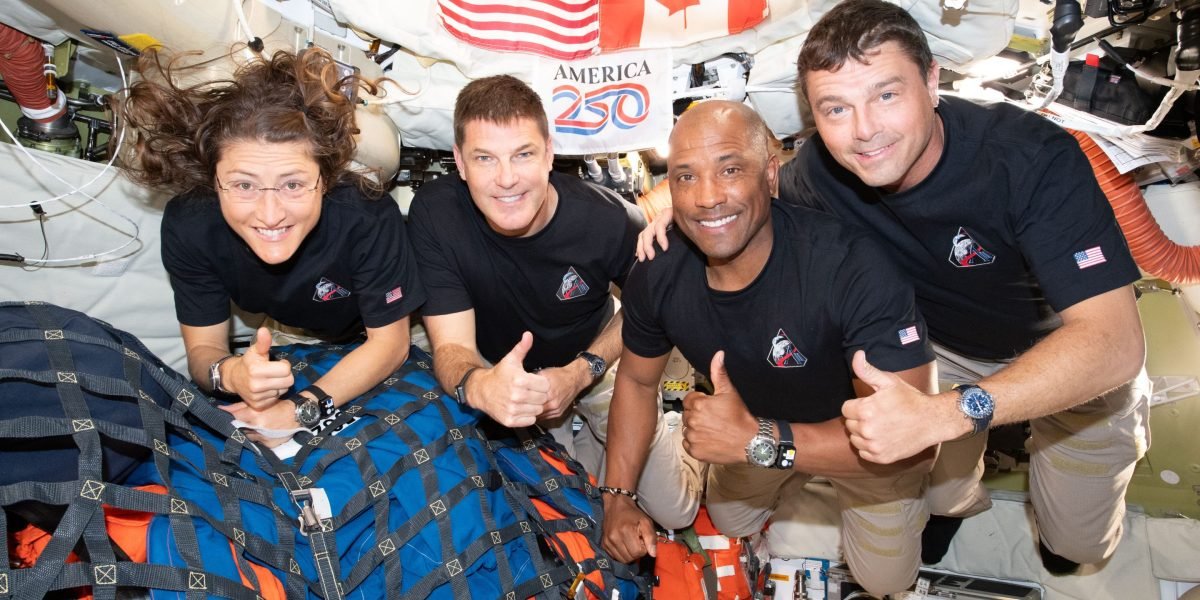
After nearly 10 days in space, complete with a historic loop around the moon, the four astronauts on NASA’s Artemis II mission faced their most dangerous moment yet: not in deep space, but in the final 13 minutes of their journey home.
“It’s 13 minutes of things that have to go right,” said NASA’s Artemis II flight director Jeff Radigan on Thursday at a news briefing.
Before the Orion spacecraft, named Integrity by the crew, ever left the Kennedy Space Center launchpad in Florida on April 1, NASA knew there was a problem. During the unmanned Artemis I mission in 2022, engineers discovered more than 100 locations on the Orion heat shield that had cracked and broken off during reentry.
Here’s the issue: it’s not supposed to do that. The shield was designed to melt away, not pop off in chunks. Instead, scientists discovered the culprit was a pressure problem buried within the shield itself. As the capsule dipped into the atmosphere, internal layers became scorching hot through a process called pyrolysis, trapping gas.
When the capsule briefly climbed back out of the atmosphere during its “skip” (meaning skip entry, which is when a spacecraft returning from high speed dips into the earth’s upper atmosphere. It’s the guided maneuver it uses to skip along the layer, closely mirroring a stone “skipping” across a pond, all before it reenters for a final landing. The outer layer hardened and became impermeable. This posed a problem because the gas had nowhere to go. On the second descent, the pressure burst through, taking chunks of the heat shield with it.
Now you’re wondering, that was Artemis I, surely they would never put four people—commander Reid Wiseman, pilot Victor Glover, and mission specialists Christina Koch and Jeremy Hansen—aboard a ship with such flaws. And you’d be partially right: the Artemis II has, remarkably, an even less permeable shield than the one on Artemis I, meaning the same failure mode was even more likely to occur.
It’s all about the right angle
Rather than delay the mission by more than a year to install a redesigned heat shield (as one engineer wanted), NASA flew Artemis II with the same flawed design and simply changed how the capsule returned. The solution was counterintuitive, with NASA instructing the crew to apply more heat more consistently. This shortened the skip phase and maintained higher temperatures throughout the descent, ensuring the outer char layer never cooled sufficiently to trap gas beneath it.
So these four astronauts, who broke a 56-year-old distance record and became the furthest humans to travel from earth when the mission brought them around the moon, not only had to overcome faulty Outlook problems and smelly toilet issues, but they had to enter the earth’s atmosphere at the right angle, at the right speed, and the right time—and they did it.
The four astronauts reached speeds of over 24,000 mph, equivalent to traveling across the continental U.S. in about six minutes. The 16.5-foot-wide heat shield reached approximately 5,000 degrees Fahrenheit, about half the temperature of the sun’s visible surface. The steeper, hotter trajectory also gave the capsule less range to maneuver away from bad weather near the Pacific splashdown zone.
It paid off
Not everyone was on board with the plan. Former NASA engineer Dr. Charles Camarda had publicly warned that NASA didn’t fully understand the root cause of the cracking and that the modified trajectory amounted to “playing Russian roulette.” But NASA stood by its data. Associate administrator Amit Kshatriya pointed to Artemis I flight data, ground testing, and engineering models as justification, and Glover acknowledged the risk head-on, noting the heat shield and parachutes are systems with zero fault tolerance built in.
The capsule splashed down safely in the Pacific, capping the first crewed lunar mission since Apollo 17 in 1972.
