


The U.S.-China rivalry has produced an “over-securitization of almost everything,” a leading Chinese strategist said Tuesday, adding that the current moment echoes the period leading up to the Second World War.
“In technological innovation, the U.S. has many opportunities and should be more confident in competing [with China],” Yu Tiejun, president of Peking University’s Institute of International and Strategic Studies, said at the Asia New Vision Forum in Singapore on Sept. 29.
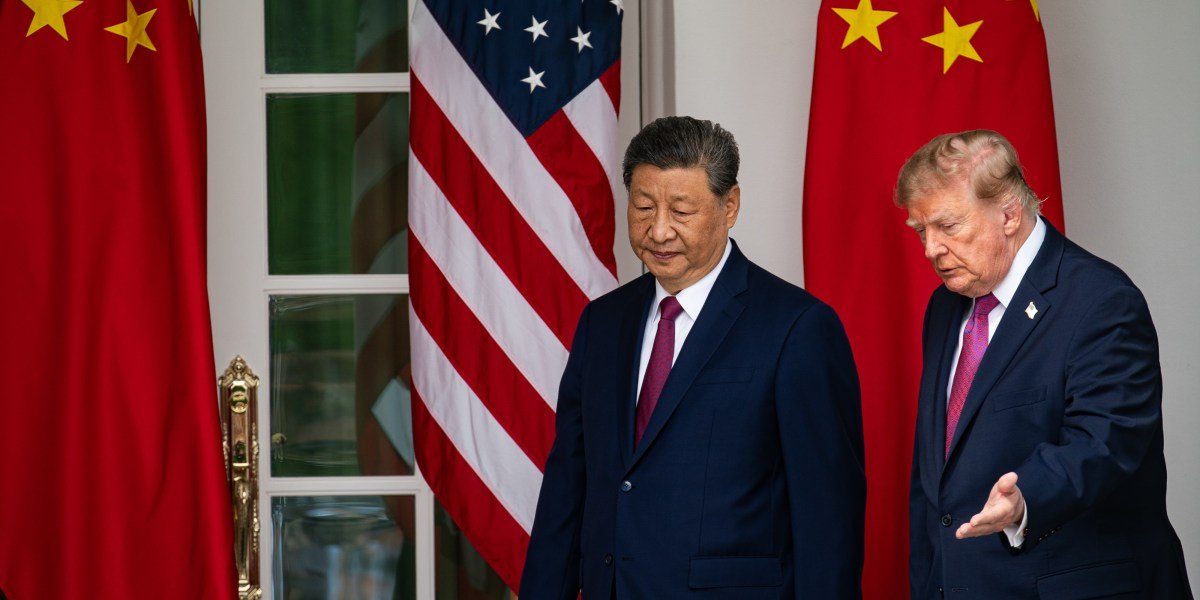
Diplomatic relations between the U.S. and China warmed slightly after Chinese President Xi’s visit to Washington last week, where the two leaders inked a two-month extension to their bilateral trade truce.
The mild thaw is a welcome shift from a typically tense relationship between the world’s two largest economies. Relations between Beijing and Washington have steadily worsened over the past decade, with increasingly harsh rhetoric and growing worries that one is trying to suppress the other.
“Nowadays, there’s an over-securitization of almost everything: it feels like the 1930s, with rising nationalism and populism between the different powers,” Yu said.
Washington has little reason to be anxious, he argued, thanks to the U.S.’s deep capital markets.
The top U.S. tech firms spent more than $400 billion in capital expenditures in 2025, compared with just $63 billion for Chinese tech firms, according to the Boston Consulting Group. Anthropic’s and OpenAI’s valuations also significantly outstrip those of DeepSeek, Moonshot AI and others.
Yu echoed Xi’s vision for an equal and orderly multipolar world. “China wants to be a stabilizing force, [especially as] the U.S. and Russia—two of the world’s biggest countries—are involved in regional conflicts.”
Joseph Liow, dean of the Lee Kuan Yew School of Public Policy (LKYSPP) and Yu’s fellow panelist, noted that both powers should find opportunities to collaborate. “There are areas in technology where the U.S. and China can cooperate for the betterment of humanity,” he said, pointing to AI governance and biotechnology as potential points of collaboration. “The problem is politics, basically.”
‘A moving target’
Smaller nations, like those in Southeast Asia, are increasingly forced to pick between the U.S. and China. According to Liow, the key is to pursue strategic autonomy.
“Countries need to have the space to pursue their own interests in the way they see fit,” he said. “This isn’t about being independent from the rest of the world… but about managing their dependence on external powers such that those dependencies don’t become vulnerabilities.”
Southeast Asia’s economy is also growing steadily. On Sept. 23, the Asian Development Bank (ADB) raised its growth forecasts for the region to 4.7% in 2026 and 4.9% in 2027. Yet, growth across countries is uneven and regional integration remains difficult, as each Southeast Asian country has different national interests.
ASEAN integration is still a “moving target,” Liow explained. “We can never [seem to] find an endpoint.” (Singapore, which is set to chair the bloc in 2027, has pledged to strengthen Southeast Asia’s centrality and unity.)
Southeast Asia can also tap broader regional coalitions like the ASEAN+3 framework, which links member states with China, Japan and South Korea, said Yasuto Watanabe, director of the ASEAN+3 Macroeconomic Research Office (AMRO).
“The ASEAN+3 region has been using a growth model which is based on openness and integration,” Watanabe concluded. “This is a solid growth model that would not be threatened by a single shock.”
